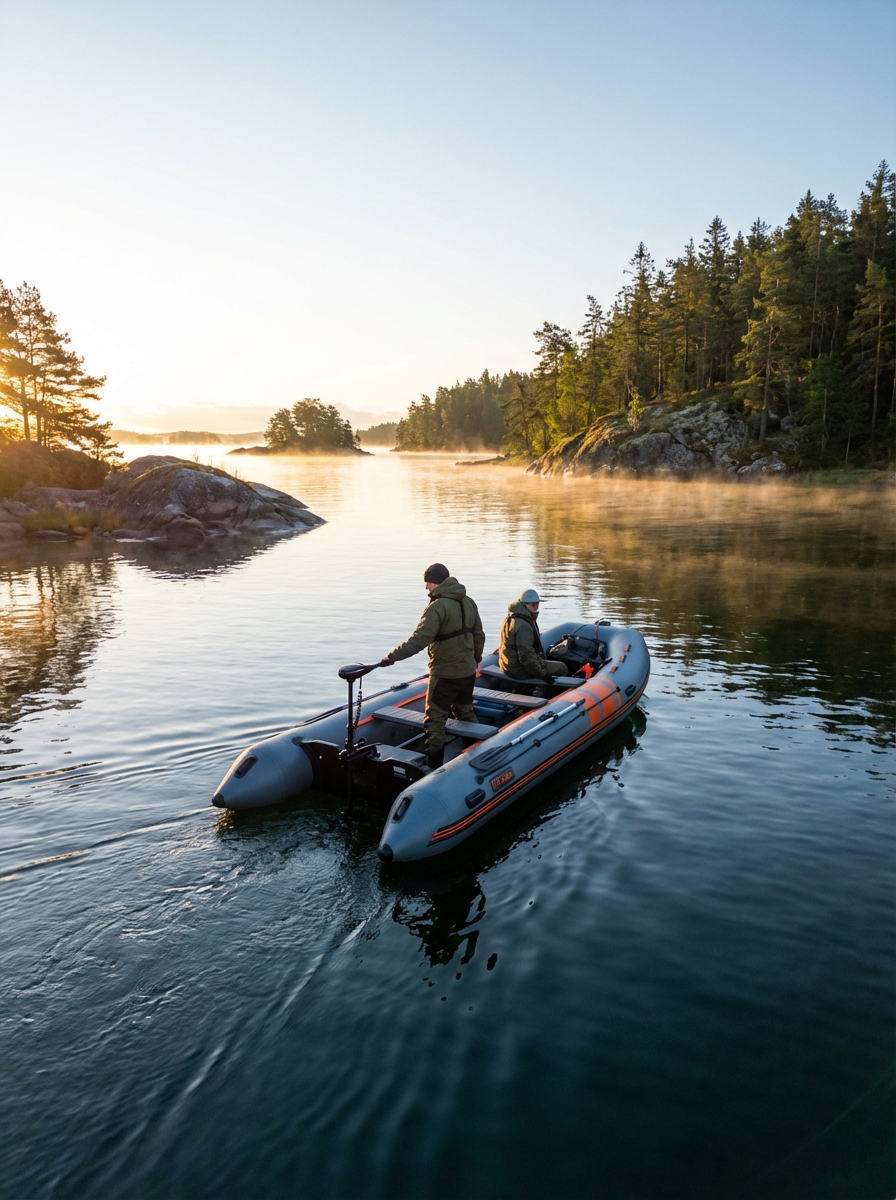
The first time I put my inflatable catamaran in the water, I paddled it. That lasted about forty-five minutes before my arms felt like overcooked spaghetti and I'd traveled maybe half a mile against the current.
I ordered a trolling motor that night.
Two years later, I run an electric trolling motor with a wireless remote on my Sea Eagle PaddleSki 437ps. I fish from it multiple times a week in the back bays near my house on Long Island. And the single biggest upgrade I've made to this boat wasn't a fancy fish finder or a premium seat. It was adding the motor.
If you're looking at an inflatable catamaran with motor capability, or you already own a cat and want to motorize it, this guide covers everything I've figured out through trial and error. Motor types, mount options, HP limits, and the specific combos that actually work well together.
Quick note: Some links on this page earn me a small commission if you buy through them. Doesn't cost you anything extra. It helps me keep testing gear and writing about it, which my wife tolerates as long as it stays in the garage.
Why Put a Motor on an Inflatable Catamaran?
I know what you're thinking. "It's an inflatable. Just paddle it." And yeah, you can. I still paddle mine sometimes when I'm fishing close to the launch. But here's why a motor changes the whole equation.
Range. Without a motor, you're limited to whatever your arms can handle. That's maybe a mile or two before you're cooked. With even a basic electric trolling motor, you can cover 5-10 miles on a single battery charge. Suddenly, spots that were "too far" are totally reachable.
Current and wind. On Long Island, the tidal currents can rip pretty good. Paddling against that in a catamaran is a workout I don't need. The motor handles it without breaking a sweat. Same with headwinds. A trolling motor just pushes through it while I sit there sipping coffee.
Fishing. This is the big one. A trolling motor lets you hold position, troll at precise speeds, and reposition quietly without spooking fish. Try doing all of that with a paddle in one hand and a rod in the other. I'll wait.
It's still not a "real" boat. An inflatable catamaran vs. a traditional boat is still a fraction of the cost, still stores in the garage, and still doesn't need a marina slip. Adding a motor gives you 80% of the performance without any of the real-boat headaches.
Electric Trolling Motor vs. Gas Outboard: Which One?
This is the first decision you need to make, and it's an easy one for most people.
I went electric. I'd do it again every time for the type of fishing and boating I do. But gas has its place too. Here's the honest breakdown.
Electric Trolling Motor
Who it's for: Fishermen, short-trip cruisers, anyone who doesn't need to go fast.
Electric trolling motors are silent, lightweight, and basically maintenance-free. You charge a battery, clamp the motor to your mount, and go. No gas cans, no oil mixing, no winterizing, no smelling like a marina when you get home.
I use mine with a wireless remote, which means I can steer the boat from my seat while I'm casting. That feature alone is worth every penny. You don't realize how much you hate getting up to adjust the motor until you don't have to anymore.
The downsides? Speed and range. You're getting 3-5 mph tops with most trolling motors. And your battery gives you maybe 2-5 hours of continuous running, depending on the thrust setting. For my use (fishing in protected bays within a few miles of the launch), that's more than enough. If you need to cover 20 miles of open water, electric isn't your answer.
Cost: A solid trolling motor runs $150-$400. A 12V deep cycle marine battery is another $100-$200. Total setup for under $600.
Gas Outboard
Who it's for: People who want speed, longer range, or plan to carry heavier loads.
Gas outboards give you real power. A 6 HP four-stroke on a 12-foot inflatable catamaran will get you planing at 10-12 mph. On a bigger cat like the Sea Eagle FastCat14, a 20 HP motor pushes speeds up to 23 mph. That's legitimate cruising.
Gas also gives you unlimited range. Bring extra fuel and you can go all day. No worrying about battery life.
The downsides? Weight, noise, maintenance, and cost. A 6 HP outboard weighs 55-65 lbs. That's a lot of extra weight on the stern of an inflatable. You need to mix fuel, change oil, winterize, and deal with the occasional "why won't this start" moment. And gas outboards cost $1,500-$3,000+ for quality brands like Honda or Tohatsu.
There's also the noise factor. Gas motors scare fish. If you're fishing, that matters.
My Recommendation
If you're fishing, cruising bays, or just want to enjoy being on the water without a lot of hassle, go electric. If you need speed, plan to cover long distances, or want to pull a tube for the kids, go gas.
For what it's worth, probably 80% of inflatable catamaran owners I've talked to run electric. It just makes more sense for how most people use these boats.
| Feature | Electric Trolling Motor | Gas Outboard |
|---|---|---|
| Speed | 3-5 mph | 8-23 mph |
| Weight | 15-30 lbs (motor only) | 40-70 lbs |
| Noise | Nearly silent | Loud |
| Range | 2-5 hours per charge | Unlimited (carry fuel) |
| Maintenance | Almost none | Oil, fuel, winterizing |
| Cost | $150-$400 + battery | $1,500-$3,000+ |
| Best for | Fishing, short cruises | Speed, distance, heavy loads |
Motor Mount Options for Inflatable Catamarans
Your motor is only as good as the mount holding it. There are three main types, and which one you need depends on your boat and motor.
Built-in Transom
Some inflatable catamarans come with a hard transom already attached. The Sea Eagle FastCat14 has a removable transom that accepts gas outboards up to 20 HP (15-inch short shaft, 125 lbs max). If your cat has a built-in transom, you're good to go. Just bolt on the motor and launch.
Bolt-On Stern Motor Mount
This is what most inflatable catamaran owners use for electric motors and smaller gas outboards. It's a bracket that clamps or bolts onto the rear crossbar of the catamaran. Sea Eagle sells the SE9 Motor Mount that works with the PaddleSki 437ps and several other models. This is what I use.
These mounts typically handle up to 3-6 HP gas or 55 lb thrust electric motors. They're removable, so you can take them off when you want to paddle instead.
Bow Motor Mount
A bow-mounted electric trolling motor sits at the front of the boat. This is a common setup for serious fishermen because it pulls the boat (instead of pushing it), which gives you better directional control and keeps the back of the boat clear for casting.
Sea Eagle makes a dedicated bow motor mount for the FastCat14 that accepts trolling motors up to 55 lb thrust. If you're doing a lot of fishing from a bigger cat, a bow mount is worth considering.
Best Motor and Inflatable Catamaran Combos
Not every motor works with every boat. Here are the combinations that actually make sense, organized by what you're trying to do.
Best for Fishing: Sea Eagle PaddleSki 437ps + Electric Trolling Motor
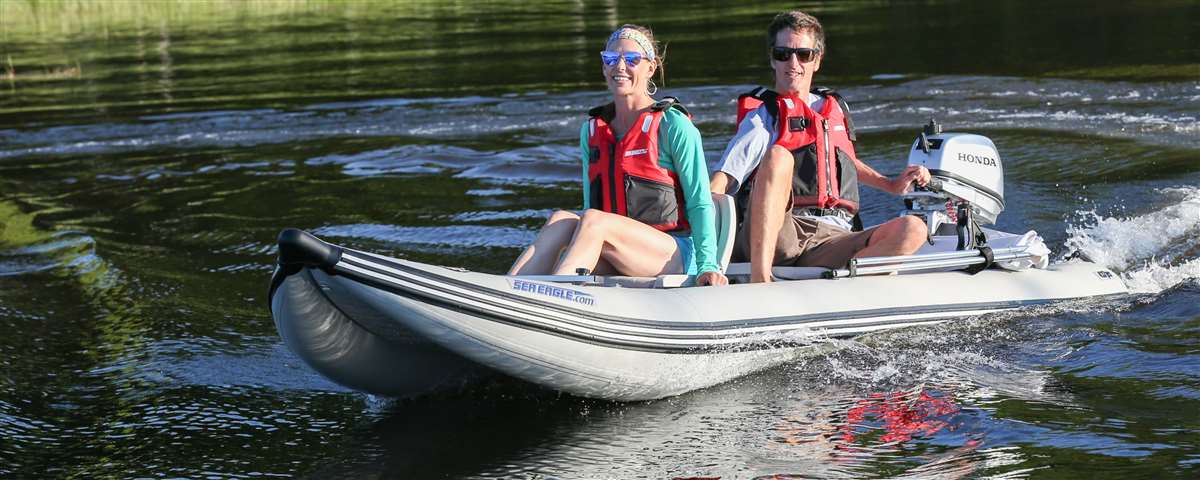
This is my setup. I'm biased because I own it and fish from it constantly, but it genuinely is the best fishing combo for the money.
The PaddleSki 437ps is a 14-foot catamaran-style inflatable that weighs about 60 lbs. It's rated for the SE9 Motor Mount, which accepts electric trolling motors and small gas outboards. I run a 55 lb thrust electric trolling motor with a wireless remote, powered by a 12V deep cycle marine battery.
Why it works for fishing: The twin hulls are crazy stable. I stand up and cast from it regularly. The motor is whisper-quiet, so I don't scare fish. And the wireless remote means I can adjust speed and direction without moving from my spot.
Realistic speed: About 4 mph at full throttle. That's not fast, but for fishing in back bays and coves, I don't need fast. I need quiet and maneuverable.
Battery life: I get about 3-4 hours on a single charge at mixed speeds. I've never run out on a fishing trip. If you're worried, bring a second battery.
What I'd change: Honestly? Not much. If I were starting over, I might look at a slightly higher thrust motor for dealing with strong tidal currents. But the 55 lb thrust handles everything I throw at it 95% of the time.
Price: The PaddleSki 437ps starts around $1,299. Motor, mount, and battery add roughly $400-$600 depending on what you pick. So you're looking at under $2,000 for a complete motorized fishing catamaran that fits in a pickup truck. That passes the "is this worth sleeping on the couch" test pretty easily.
Best for Speed and Families: Sea Eagle FastCat14 + Gas Outboard
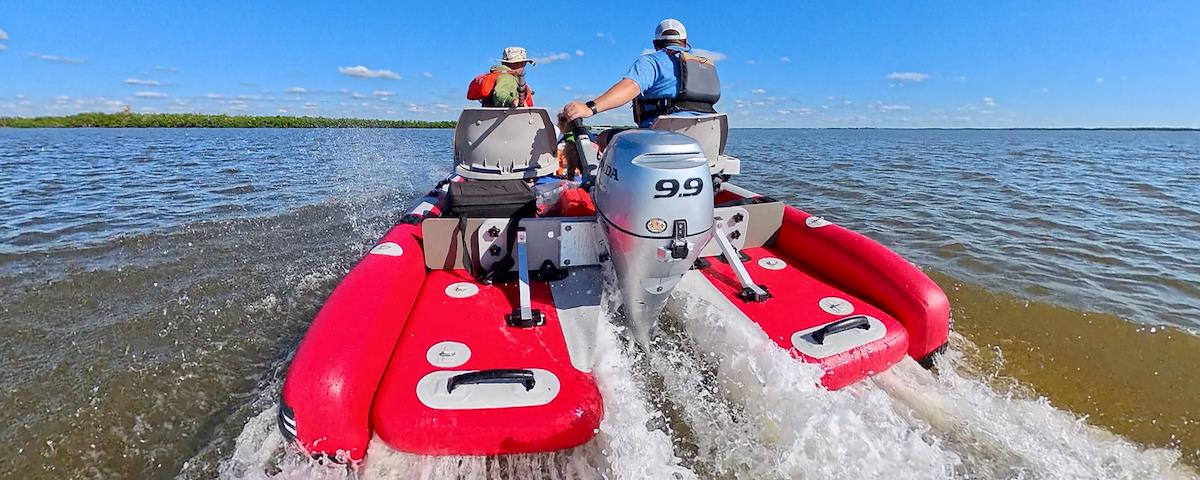
If you want to actually go somewhere, the FastCat14 is the inflatable catamaran to do it with. This thing is a beast. 14 feet long, 6'8" beam, 1,600 lb capacity, and a transom rated for up to 20 HP.
Pair it with a Honda 9.9 HP four-stroke and you're looking at about 16 mph. Step up to a 20 HP and it'll hit 23 mph. That's fast enough to pull a tube, cruise to a sandbar, or make a longer run to a distant fishing spot.
I haven't personally used the FastCat14, but I've seen them on the water and talked to a couple of owners. The consistent feedback is that it handles like a much bigger boat, especially with a motor. The wide catamaran hull design keeps it stable even at speed.
Price: The FastCat14 starts at $3,199. A Honda 9.9 HP outboard adds about $2,500-$3,000. It's a bigger investment, but still a fraction of what a comparable rigid hull boat would cost.
Best Budget Option: Saturn SD365 + Electric Trolling Motor
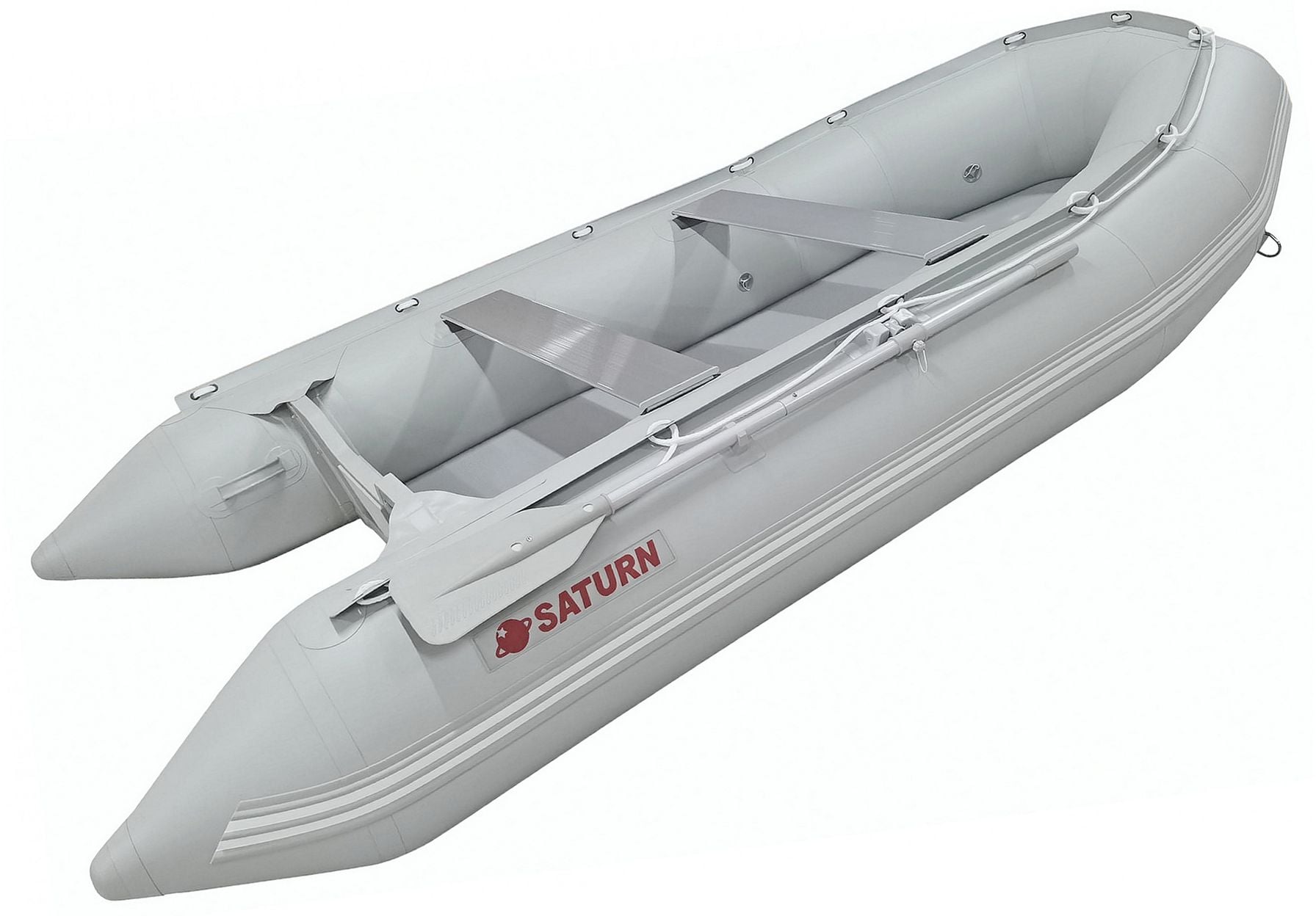
I haven't personally tested a Saturn, but they come up a lot in forums and reviews. The SD365 is a 12-foot inflatable catamaran that runs under $1,000. It accepts small gas outboards (up to about 6 HP) and electric trolling motors.
A Saturn paired with a basic 30-40 lb thrust trolling motor and a marine battery gets you on the water for about $1,300 total. That's hard to beat if you're not sure whether motorized catamaran life is for you and don't want to drop $2,000+ to find out.
Fair warning on Saturn: Build quality isn't at the same level as Sea Eagle. You'll see some glued seams instead of welded, and the materials are thinner. For occasional weekend use, it's fine. For heavy, year-round fishing? You might outgrow it in a season or two.
Comparison Table: Motorized Inflatable Catamaran Setups
| Setup | Boat Price | Motor Type | Max Motor | Top Speed | Total Cost | Best For |
|---|---|---|---|---|---|---|
| PaddleSki 437ps + Electric | $1,299 | 55 lb thrust electric | SE9 mount rating | ~4 mph | ~$1,800 | Fishing, solo/duo cruising |
| FastCat14 + Gas | $3,199 | Up to 20 HP outboard | 20 HP / 125 lbs | ~23 mph | ~$5,700 | Speed, families, distance |
| FastCat14 + Electric Bow | $3,199 | 55 lb thrust bow mount | 55 lbs max | ~4-5 mph | ~$3,800 | Fishing from larger platform |
| Saturn SD365 + Electric | ~$950 | 30-40 lb thrust electric | ~6 HP equiv. | ~3 mph | ~$1,300 | Budget entry, casual use |
How to Set Up a Motor on Your Inflatable Catamaran
If you've never mounted a motor on an inflatable, here's the process. It's simpler than you'd think.
Step 1: Install the Motor Mount
Inflate the boat first. Then attach the motor mount to the designated mounting point. On the PaddleSki 437ps, the SE9 mount clamps to the rear crossbar. It takes about five minutes with no tools. Line up the bracket, tighten the clamps, and you're set.
Step 2: Attach the Motor
For electric trolling motors, the clamp bracket tightens onto the motor mount plate with a hand screw. No tools needed. For gas outboards, you'll bolt the motor to the transom plate using the standard clamp system that comes with the outboard.
Step 3: Connect Power
Electric motors connect to a 12V marine deep cycle battery with alligator clips or quick-disconnect terminals. Set the battery in the bottom of the boat, ideally centered or slightly forward of the motor to balance weight. I put mine right behind my seat.
Gas outboards just need fuel and a pull start. Nothing to connect beyond the fuel line if you're using an external tank.
Step 4: Test Before You Go Deep
First time out, stay close to the launch. Test your steering, throttle response, and battery life. Make sure the motor mount is tight and the motor isn't cavitating (sucking air instead of pushing water). If the prop breaks the surface on turns, your shaft might be too short.
Tips I Learned the Hard Way
- Bring a paddle as backup. Batteries die. Motors get tangled in seaweed. Don't be the guy drifting toward the bridge pylon with no way to steer.
- Secure your battery. A loose 40 lb battery sliding around in the bottom of your boat is a bad time. Bungee it down or use a battery box with a strap.
- Use a kill switch lanyard. Especially with gas motors. If you fall overboard, you want the motor to stop.
- Keep the prop clean. Inflatable catamarans run in shallow water. You'll pick up weeds, fishing line, and the occasional plastic bag. Check the prop every hour or so.
Gear You'll Need (Beyond the Boat and Motor)
A motor and a boat are only half the equation. Here's what else you'll want:
- Deep cycle marine battery: For electric trolling motors, a Group 27 or 29 battery gives 3-5 hours of runtime depending on speed. I use mine all day on medium speed.
- Battery box with strap: Keeps a heavy battery from sliding around inside your boat. Non-negotiable on any inflatable.
- Trolling motor: If you haven't picked one yet, 55 lb thrust handles most inflatable catamarans up to 14 feet.
- Wireless trolling motor remote: Total quality-of-life upgrade. I steer my motor without leaving my seat.
- Paddle or telescoping oar: Always carry a backup. Batteries die at the worst possible moment.
What About Bigger Electric Motors? (ePropulsion, Torqeedo, etc.)
You might have seen higher-end electric outboards from brands like ePropulsion or Torqeedo. These are self-contained units (motor and battery in one package) that deliver 1-6 kW, which translates to roughly 3-10 HP equivalent.
The ePropulsion Spirit 1.0 Plus, for example, puts out about 3 HP equivalent, weighs 42 lbs total, and is completely silent. It's a cool piece of tech. But it also costs around $3,000, which is more than twice what my entire trolling motor and battery setup cost.
For someone running a FastCat14 who wants electric but needs more power than a trolling motor provides, these units make sense. For most of us on smaller cats doing bay fishing? A standard trolling motor does the job for a lot less money.
Internal Links Worth Reading
If you're still figuring out which inflatable catamaran to buy in the first place, start with my best inflatable catamaran guide. That covers the top picks from budget to premium.
If fishing is your main focus, check out my best inflatable fishing boat roundup. It covers options beyond just catamarans.
And if you're on the fence between an inflatable cat and a traditional boat, I wrote a detailed inflatable catamaran vs. traditional boat comparison that breaks down the real cost and convenience differences.
FAQ: Inflatable Catamaran With Motor
Can you put a motor on an inflatable catamaran?
Yes. Almost every inflatable catamaran on the market accepts a motor. Smaller models handle 3-6 HP gas or 30-55 lb thrust electric motors. Larger models like the Sea Eagle FastCat14 support up to 20 HP gas outboards. You need either a built-in transom or a bolt-on motor mount, which most manufacturers sell as an accessory.
What size motor do I need for an inflatable catamaran?
For boats under 12 feet, a 30-55 lb thrust electric trolling motor or 3-6 HP gas outboard is plenty. For 12-14 foot catamarans, 55-86 lb thrust electric or 6-20 HP gas will get you on plane. Always check the manufacturer's max HP rating before buying. Going over that limit risks damaging the transom or motor mount.
Electric trolling motor or gas outboard for an inflatable catamaran?
Electric is better for fishing, short trips, and protected water. Silent running, no fuel to spill, almost zero maintenance. Gas is better for longer distances, heavier loads, and if you need planing speed (15+ mph). Most casual users and fishermen are happier with electric. It's simpler, cheaper, and you don't come home smelling like gasoline.
How fast can a motorized inflatable catamaran go?
With an electric trolling motor, expect 3-5 mph. With a 6 HP gas outboard, some catamarans hit 10-12 mph and start planing. A 20 HP on a larger cat like the FastCat14 can reach 23 mph. Catamaran hulls are efficient, so they need less motor power than a monohull to reach the same speed.
What motor mount works for inflatable catamarans?
There are three types: built-in transoms (come with the boat), bolt-on stern mounts (sold separately, clamp to the rear crossbar), and bow motor mounts (for electric trolling motors). Sea Eagle sells dedicated mounts for each of their catamaran models. Third-party universal mounts also work but check the max HP rating and fit before buying.
Do I need a short-shaft or long-shaft motor for an inflatable catamaran?
Short shaft (15 inches) for gas outboards. Inflatable catamarans sit low to the water, so a long shaft will stick too deep and create drag. For electric trolling motors, 30-36 inch shaft length is standard and works on most inflatable catamaran motor mounts. Check your specific boat's manual for recommended shaft length.
Bottom Line
An inflatable catamaran with a motor is one of the best deals in boating. You get a stable, portable, affordable platform that performs way above its price point. The twin hull design cuts through water more efficiently than a monohull, which means your motor doesn't have to work as hard.
My setup (PaddleSki 437ps with an electric trolling motor) cost me under $2,000 total. I fish from it year-round. It lives in my garage, I load it into the truck in about ten minutes, and I launch from any kayak ramp or beach. No trailer, no marina, no headaches.
If you told me three years ago that an inflatable catamaran with a trolling motor would replace 90% of what I wanted a "real" boat for, I would have laughed. I'm not laughing anymore. I'm fishing.
How I Review Boats
I buy my own gear with my own money. No press samples, no sponsorships, no manufacturer relationships. If I own it, I'll tell you exactly what I think after months of real-world use. If I haven't used it personally, I'll say that upfront and base my assessment on specs, owner reports, and conversations with people who actually own one.
Prices checked . Some links on this page are affiliate links. If you buy through them, I earn a small commission at no extra cost to you. That's how I fund buying more gear to review. Read more about how this site works.