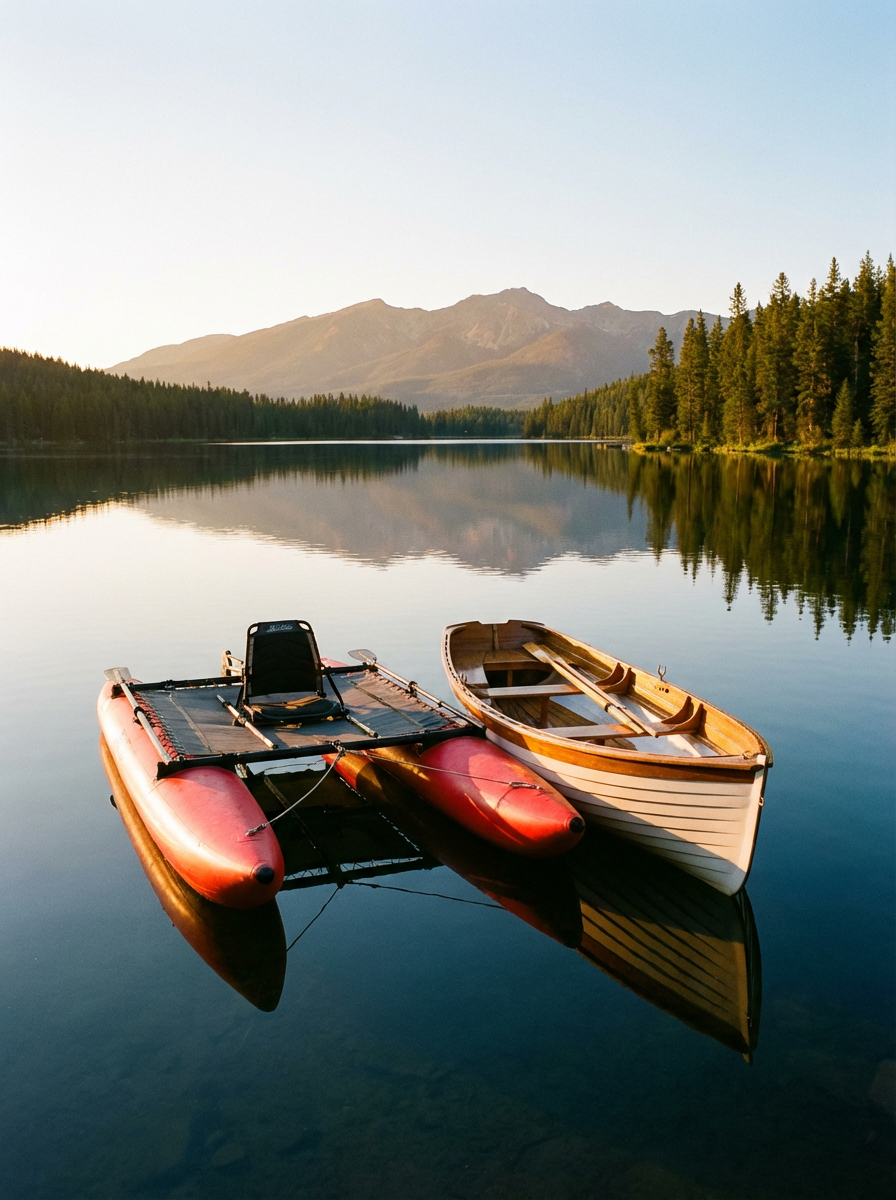
I used to own a 13-foot Boston Whaler. About the same size as the inflatable catamaran I fish from now. Same waters, same back bays on Long Island. But the experience could not have been more different.
The Whaler's trailer was always breaking something. A bearing would go, or the lights would short out, or the winch strap would fray at the worst possible time. The outboard didn't want to start half the mornings I went out. I'd be standing at the ramp pulling that cord while a line of trucks waited behind me, everybody staring. And the ramp itself was a whole production. Backing a trailer straight while some guy in a bass boat yells helpful advice from the dock. I spent more time fighting the equipment than fishing.
So I sold it. Bought a Sea Eagle PaddleSki 437ps for $1,299. Now I fish the exact same waters. I slide the boat off my truck tailgate, launch from the kayak ramp down the block, and I'm casting in under 10 minutes. No trailer. No outboard that won't start. No ramp drama. Just fishing.
That switch is why I can write this comparison honestly. I've lived both sides. The Whaler was a good boat. The inflatable is a better fit for how I actually fish. But "most people" isn't everyone, and I'm going to be straight with you about where traditional boats still win.
What I Mean by "Traditional Boat"
Before we compare anything, let me define what I'm comparing. When I say "traditional boat," I mean a hard-hull fishing boat in the 12 to 16 foot range. Aluminum jon boats, fiberglass bass boats, small center consoles. The kind of boat a normal person considers when they want to get on the water.
I'm not comparing inflatable catamarans to 30-foot offshore fishing machines. That would be ridiculous. I'm comparing them to the boats most people actually think about buying. The $8,000 to $25,000 entry-level fishing boats that sit on trailers in suburban driveways.
When I say "inflatable catamaran," I mean twin-hull inflatable boats like the Sea Eagle PaddleSki, FastCat12, and FastCat14. These are not the $89 inflatables from Walmart. These are boats built with 1000 Denier reinforced PVC, drop-stitch high-pressure floors, and multiple independent air chambers. Real boats that happen to be inflatable.
The Real Cost Comparison (This Is Where It Gets Interesting)
Everyone talks about the sticker price. Nobody talks about what a boat actually costs to own. Let me do the math that the dealer won't show you.
Traditional Boat: Year One
| Expense | Cost |
|---|---|
| 14 ft aluminum fishing boat | $8,000 - $15,000 |
| Trailer | $1,500 - $4,000 |
| Registration and title | $50 - $200 |
| Insurance | $300 - $700 |
| Safety gear (PFDs, fire extinguisher, horn) | $150 - $300 |
| First tank of gas + oil | $50 - $100 |
| Year One Total | $10,050 - $20,300 |
Traditional Boat: Every Year After That
| Expense | Annual Cost |
|---|---|
| Storage (if no home driveway) | $500 - $5,000 |
| Insurance | $300 - $700 |
| Fuel and oil | $200 - $800 |
| Maintenance (engine service, winterization) | $500 - $2,000 |
| Registration renewal | $25 - $75 |
| Misc repairs | $100 - $500 |
| Annual Total | $1,625 - $9,075 |
Inflatable Catamaran: Total Cost
| Expense | Cost |
|---|---|
| Sea Eagle PaddleSki 437ps (includes pump, paddles, seats) | $1,299 |
| Electric trolling motor (optional) | $150 - $400 |
| Battery (optional) | $80 - $200 |
| PFDs | $40 - $80 |
| Total | $1,299 - $1,979 |
Annual costs after that? Pretty close to zero. No insurance required. No registration in most states (unless you add a gas motor, which I don't). No storage fees because it lives in my garage. No winterization. No engine service.
The 5-Year Math
Over 5 years, here's what you're looking at:
- Traditional boat: $10,050 first year + ($1,625 x 4 years) = $16,550 minimum. Realistically closer to $25,000 to $35,000.
- Inflatable catamaran: $1,299 to $1,979. Period. Maybe replace the battery once.
I fish about 80 times per year. With my PaddleSki, that works out to roughly $16 per trip over two years. With a traditional boat at $25,000 all-in over 5 years, you'd need to fish 300+ times just to get under $80 per trip.
This isn't even close.
Storage and Portability
This is the section where inflatable catamarans absolutely destroy traditional boats. There's no comparison.
My PaddleSki weighs 58 pounds and packs down to 36 x 21 x 12 inches. It fits in my garage next to the lawnmower. I could fit it in a closet if I needed to. When I want to go fishing, I throw it in the bed of my truck, drive to the water, inflate it with an electric pump in about 8 minutes, and I'm fishing.
A traditional 14-foot aluminum boat weighs 400 to 800 pounds. You need a trailer. You need a vehicle that can tow it. You need somewhere to park the trailer when you're not using it. You need a driveway or a storage lot. And when you get to the water, you need a boat ramp, which on a Saturday morning means waiting in line behind six guys who forgot to pull their drain plugs.
If you live in an apartment, a condo, or anywhere with HOA restrictions on trailers, a traditional boat might not even be an option. An inflatable catamaran fits in your trunk.
If you're an RVer or a camping enthusiast, an inflatable goes wherever you go. Toss it in the RV and you have a boat at every campground with a lake.
Winner: Inflatable catamaran. This one isn't close and it's honestly the main reason I went inflatable.
Stability on the Water
People assume inflatables are tippy and unstable. That's true for cheap single-hull inflatables and pool toys. It is not true for inflatable catamarans.
A catamaran has two hulls. The PaddleSki has a beam of over 3.5 feet. That's wider than most kayaks and a lot of small aluminum boats. The twin pontoon design means you'd have to really try to flip this thing. I stand and cast from mine regularly. I've had my kid stand up in it. It's stable.
A 14-foot aluminum jon boat is also stable, but it has a narrow flat bottom that gets sketchy in chop. Aluminum boats slap against waves and bounce you around. An inflatable catamaran rides on top of the water differently. The air chambers absorb some of the impact. In 1 to 2 foot chop in the back bay, I'd honestly rather be in my PaddleSki than in a small aluminum boat.
Winner: Tie. Both are stable in their element. The catamaran wins in chop comfort. Traditional boat wins in heavy wind because it's heavier.
Performance and Speed
Here's where traditional boats pull ahead, and I'm going to be honest about it.
My PaddleSki takes a small electric trolling motor. I cruise around at 3 to 4 mph, which is perfect for fishing. If I wanted more speed, the Sea Eagle FastCat14 takes up to a 20 HP gas motor and hits 23 mph. That's respectable.
But a traditional 14-foot aluminum boat with a 25 HP outboard will do 25 to 35 mph. Put a 50 HP on a bass boat and you're north of 40 mph. If getting from point A to point B fast matters to you, traditional boats win this category.
That said, I don't need speed. I'm fishing back bays and coastal inlets. I'm not running 10 miles offshore. For the kind of fishing I do, a trolling motor with a wireless remote is perfect. I sneak up on fish instead of blasting past them.
Winner: Traditional boat. If you need speed and range, get a hard hull.
Durability: How Long Do Inflatable Boats Actually Last?
This is the question everyone asks, and it's a fair one. "What about punctures?" "Won't it pop?" "How long before it's garbage?"
According to the National Marine Manufacturers Association (NMMA), a quality inflatable boat lasts 5 to 15 years with proper care. Some owners report 20+ years on forums. The number one killer is UV exposure. Leave an inflatable in the sun all summer and it'll degrade faster. Keep it in the shade when not in use and it'll last.
Sea Eagle uses double-layer 1000 Denier reinforced PVC with quadruple overlapped glued seams. It's not the same material as a pool float. Multiple independent air chambers mean even if you somehow puncture one (which is hard to do), the boat stays afloat and you paddle home. In two years of regular use, I haven't had a single leak or repair.
Traditional aluminum boats last decades. That's a real advantage. Your grandpa's aluminum jon boat is probably still floating somewhere. Fiberglass boats also last 25 to 30 years if maintained.
But think about it this way. That aluminum boat sitting in a storage lot for $200 a month is costing you more per year in storage than the inflatable is worth. Longevity only matters if you're actually using the boat. My PaddleSki gets used because it's easy. My Whaler sat on the trailer more than it sat in the water because every trip was a production. The boat that lasts 30 years but only gets used 6 times a year isn't beating the boat that lasts 15 years and gets used 80 times a year.
Winner: Traditional boat on raw lifespan. Inflatable catamaran on cost-per-use over its life. The boat you actually use beats the boat that sits in storage.
Maintenance
Traditional boats require real maintenance. Engine oil changes, lower unit service, winterization, trailer bearings, hull cleaning, zincs, battery maintenance. I know because I did all of it on my Whaler. Or more accurately, I paid someone to do most of it when the outboard wouldn't cooperate. If you have an outboard, you're looking at $500 to $2,000 per year depending on what needs doing. Miss a winterization and you might crack your engine block. That's a $3,000 to $5,000 fix.
My inflatable catamaran maintenance routine: rinse it after saltwater. That's about it. Occasionally I put some 303 protectant on the tubes. No engine to winterize (electric trolling motor just comes inside). No hull to scrub. No trailer bearings to grease. No zincs.
I spend more time fishing and less time maintaining. That's the whole point.
Winner: Inflatable catamaran. It's not even a conversation.
Who Should Buy a Traditional Boat
I'm not going to sit here and pretend inflatable catamarans are perfect for everyone. Traditional boats are the right call if:
- You run offshore regularly. If you're fishing 5+ miles out in open water, you need a hard hull with real horsepower. Period.
- Speed matters to your fishing style. If you run from spot to spot all day and need to cover 20 miles of water, you need a fast boat.
- You already have the infrastructure and it works. If you own a house with a driveway, a truck with a hitch, a trailer that doesn't break, and you live 10 minutes from a boat ramp, the convenience argument for inflatables shrinks. My trailer was always breaking something. If yours isn't, count yourself lucky.
- You want to fish 4+ people. Most inflatable catamarans max out at 2 to 4 passengers. A 16-foot aluminum boat can comfortably hold 4 to 6.
- You plan to own it for 20+ years. If you want a boat that outlasts you, aluminum and fiberglass win the longevity game.
If three or more of those describe you, get a traditional boat. Seriously. I'm not trying to sell you something that doesn't fit your life.
Who Should Buy an Inflatable Catamaran
An inflatable catamaran is the better choice if:
- Budget is real. You want to fish without spending $15,000 to $30,000. The PaddleSki is $1,299 and includes everything you need except a motor.
- Storage is limited. Apartment, condo, small garage, HOA restrictions. The inflatable disappears into a corner when you're done.
- You fish solo or with one other person. Two seats, two fishing spots. That's my setup and it works great.
- You want simplicity. No trailer. No ramp. No engine service. No insurance. No registration headaches. Throw it in the truck, inflate, fish, deflate, go home.
- You fish protected waters. Bays, rivers, lakes, inlets, ponds, creeks. Anywhere that doesn't require running through 4-foot swells.
- You're an RVer or camper. An inflatable goes wherever you go. A traditional boat goes where the trailer goes.
If that sounds like you, an inflatable catamaran will change your fishing life. It changed mine. With the Whaler I fished maybe 10 times a year because every trip was a fight with the trailer, the outboard, and the boat ramp. With the PaddleSki I fish 80+ times because the barrier to entry dropped to basically zero. Same waters. Ten times the trips.
My Recommendation: The Sea Eagle PaddleSki 437ps
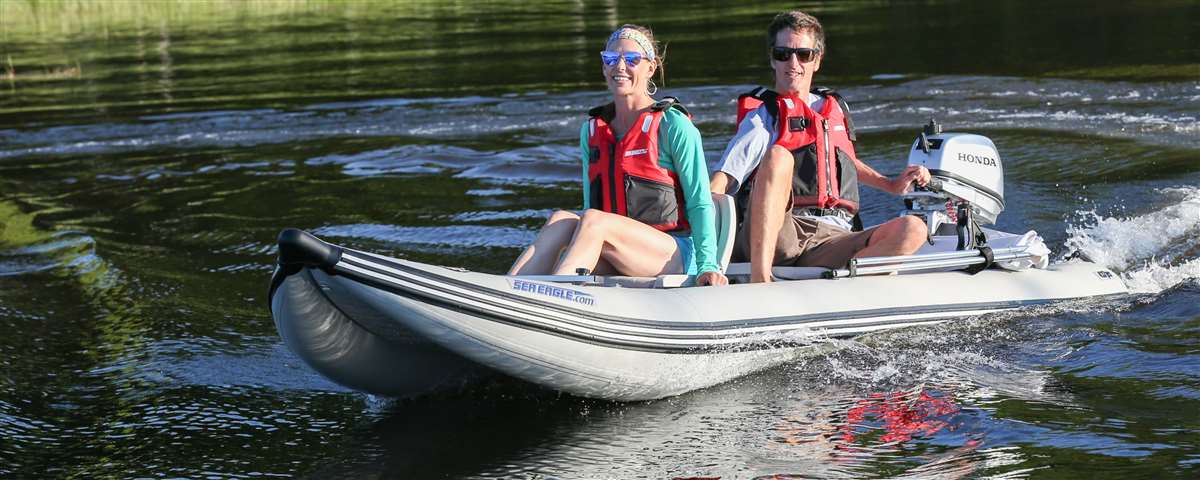
I own this boat. I fish from it year-round. I bought it with my own money. Full disclosure: I earn a commission if you buy through my link. That's how I fund buying more cool stuff to review. But I'd recommend this boat even without the commission because it genuinely changed how often I get on the water.
Sea Eagle PaddleSki 437ps - $1,299
- 58 lbs (one person can carry it to the water)
- 855 lb capacity
- Fits a trolling motor
- Packs to 36" x 21" x 12"
- Double-layer 1000 Denier reinforced PVC
- Multiple independent air chambers
- High-pressure drop-stitch floor (rigid underfoot)
I pair mine with an electric trolling motor and a wireless remote. Total setup cost including motor and battery was under $1,800. I keep it inflated in my garage so I can grab it and go. On days when I'm feeling lazy, I paddle instead of motoring. It works both ways.
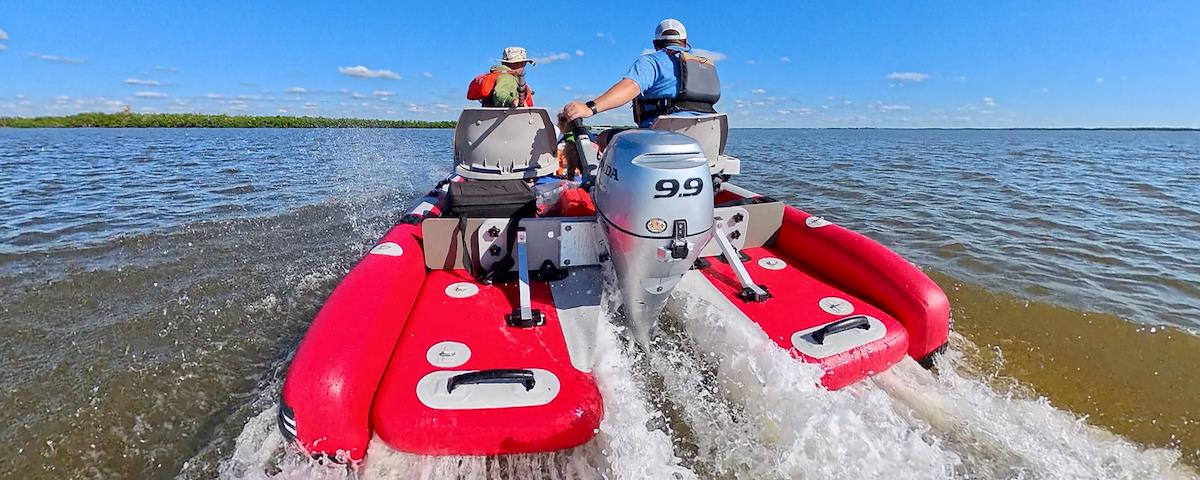
If you need more speed and capacity, look at the Sea Eagle FastCat14 ($3,199 starting). It takes up to a 20 HP motor, hits 23 mph, holds 4 people and 1,600 lbs. That's getting close to traditional boat performance at a fraction of the cost.
Side-by-Side Comparison Table
| Factor | Inflatable Catamaran | Traditional Boat (14 ft aluminum) |
|---|---|---|
| Purchase price | $1,299 - $3,199 | $8,000 - $25,000 |
| Year 1 total cost | $1,299 - $1,979 | $10,050 - $20,300 |
| Annual ongoing cost | ~$0 | $1,625 - $9,075 |
| 5-year total cost | $1,300 - $2,000 | $16,550 - $56,600 |
| Weight | 58 - 126 lbs | 400 - 800 lbs |
| Storage | Garage corner or closet | Driveway, storage lot, or marina |
| Trailer needed | No | Yes ($1,500 - $4,000) |
| Setup time | 8 - 10 minutes | Hook up trailer, drive, launch, park |
| Top speed | 4 mph (electric) to 23 mph (gas) | 25 - 45 mph |
| Max passengers | 2 - 4 | 4 - 6 |
| Lifespan | 5 - 15 years | 20 - 30+ years |
| Stability | Excellent (twin hull) | Good (flat bottom) |
| Maintenance | Rinse after use | Engine service, winterization, hull care |
| Insurance | Not required | $300 - $700/year |
| Registration | Usually not required | Required |
| Fishing comfort | Very good (stable, quiet, shallow draft) | Very good (more space, more storage) |
| Rough water | Good in 1-2 ft chop | Better in 3+ ft seas |
Frequently Asked Questions
Are inflatable boats as safe as regular boats?
Modern inflatable boats are very safe. They use multiple independent air chambers, so if one gets punctured, the others keep you floating. The PVC and Hypalon materials used in quality inflatables are the same technology behind professional rescue and military craft. Inflatable catamarans add extra stability with their twin-hull design. I've never felt unsafe on mine.
How long do inflatable boats last?
Quality inflatables last 5 to 15 years. Some owners report 20+ years. The biggest threat is UV exposure, not punctures. Store it out of direct sunlight, rinse after saltwater, and it'll last. Budget inflatables from big box stores are a different story. Those last 1 to 2 seasons. You get what you pay for.
What are the disadvantages of inflatable boats?
The honest downsides: lower top speed (most cap out at 15 to 23 mph), limited horsepower options, vulnerability to UV over time, and 8 to 10 minutes of setup with an electric pump. They're also not ideal for serious offshore fishing in heavy seas. For protected waters like bays, lakes, and rivers, these downsides rarely matter.
Can inflatable boats handle rough water?
Inflatable catamarans handle moderate chop well. The twin hulls cut through waves instead of bouncing over them. I fish in the back bay with 1 to 2 foot wind chop regularly and it handles fine. For open ocean with 3+ foot seas, stick with a traditional hard hull. Know your limits and the weather forecast.
Are inflatable boats worth the money?
Do the math. My PaddleSki cost $1,299. Over two years of fishing 80 times per year, that's $8 per trip. A traditional boat at $25,000 over 5 years is north of $80 per trip for most people. The inflatable costs less, gets used more, and requires zero ongoing expense. For most recreational anglers, it's the smarter financial move.
Does an inflatable boat need a license or registration?
In most US states, unpowered inflatables don't require registration. Add a gas motor and you'll typically need to register ($25 to $75 in most states). An electric trolling motor usually doesn't trigger registration requirements, but check your state laws. Traditional boats almost always need registration, title, and often a boating safety certificate.
Can you stand and fish in an inflatable catamaran?
Yes. This is one of the biggest advantages of the catamaran design. The twin pontoon hulls create a wide, stable platform. The PaddleSki has a beam of over 3.5 feet. I stand and cast from mine all the time. Way more stable than standing in a kayak or a narrow aluminum boat.
What is the best inflatable catamaran for fishing?
I'm biased because I own one, but the Sea Eagle PaddleSki 437ps is my pick. 58 lbs, fits a trolling motor, $1,299 all-in. If you want more power, the FastCat14 takes up to 20 HP and holds 4 people. Check out my full guide on the best inflatable catamarans for the complete rundown.
Internal links included:
Affiliate disclosure: Some links on this site earn me a commission. It doesn't cost you anything extra, and it helps me keep buying cool stuff to review. Win-win.
How I Review Boats
I buy my own gear with my own money. No press samples, no sponsorships, no manufacturer relationships. If I own it, I'll tell you exactly what I think after months of real-world use. If I haven't used it personally, I'll say that upfront and base my assessment on specs, owner reports, and conversations with people who actually own one.
Prices checked . Some links on this page are affiliate links. If you buy through them, I earn a small commission at no extra cost to you. That's how I fund buying more gear to review. Read more about how this site works.