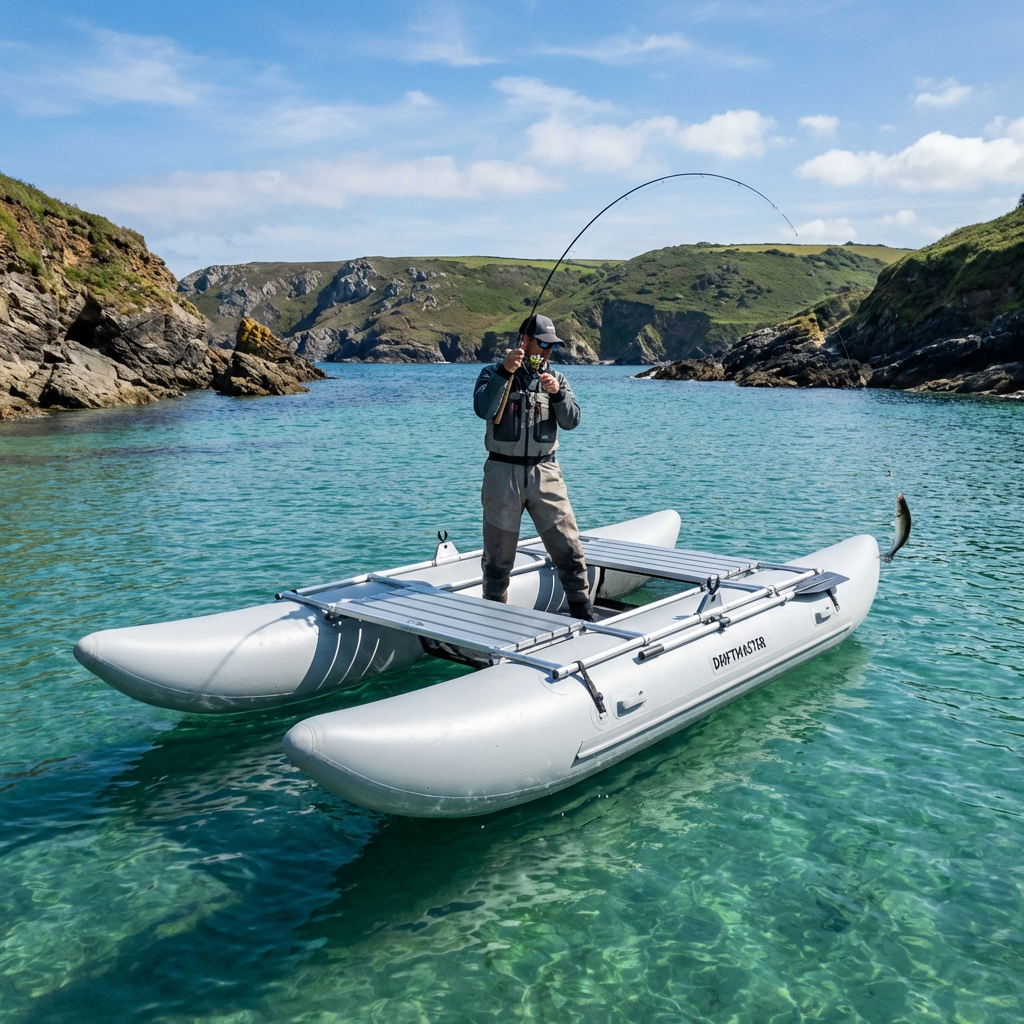
Two years ago I was standing on a seawall watching a guy in a bass boat pull fish after fish from a flat I couldn't reach. I had my rod. I had the bait. I had nothing to get me out there. A kayak felt too cramped for a bigger guy like me. A real boat? With three kids, I couldn't justify a $20,000 purchase, a trailer, and a marina slip.
So I bought an inflatable catamaran. Specifically, a Sea Eagle PaddleSki 437ps. I've had it for two years now. I fish from it in the back bays near my house, launching from a little kayak ramp down the block. Almost daily the first year. Still multiple times a week when the weather cooperates.
And I can tell you with confidence that every "best inflatable catamaran" article I read before buying was garbage. Manufacturer pages pretending to be reviews. AI-generated lists with specs pulled from Amazon. Nobody actually owned one of these things.
This is the guide I needed back then. Five picks. Real specs. Honest opinions from someone who spent his own money. Not from a "review team" that doesn't exist.
Quick heads up: some links on this page earn me a commission if you buy through them. Doesn't cost you a penny extra. It's how I fund buying more gear to write about, which my wife tolerates as long as I keep it to the garage. Everybody wins.
Quick Picks: Best Inflatable Catamarans at a Glance
| Category | Pick | Price | Capacity | Motor | Best For |
|---|---|---|---|---|---|
| Best Overall | Sea Eagle FastCat14 | $3,199 | 1,600 lbs / 4 people | Up to 20 HP | Families, groups, all-around use |
| Best for Fishing | Sea Eagle FoldCat 375fc | $1,499 | 650 lbs / 2 people | Up to 3 HP gas | Stand-up fishing, anglers |
| Best for Couples | Sea Eagle PaddleSki 437ps | $1,299 | 855 lbs / 2 people | Up to 6 HP gas | Paddle + fish + motor combo |
| Best Budget | Saturn SD365 | ~$1,050 | 4 people | Compatible | First-timers, casual use |
| Best Premium Tender | Takacat T340LX | ~$2,500+ | 1,135 lbs / 5 people | Up to 10 HP | Yacht tenders, shallow water |
Best Inflatable Catamarans: Full Reviews
Best Overall: Sea Eagle FastCat14
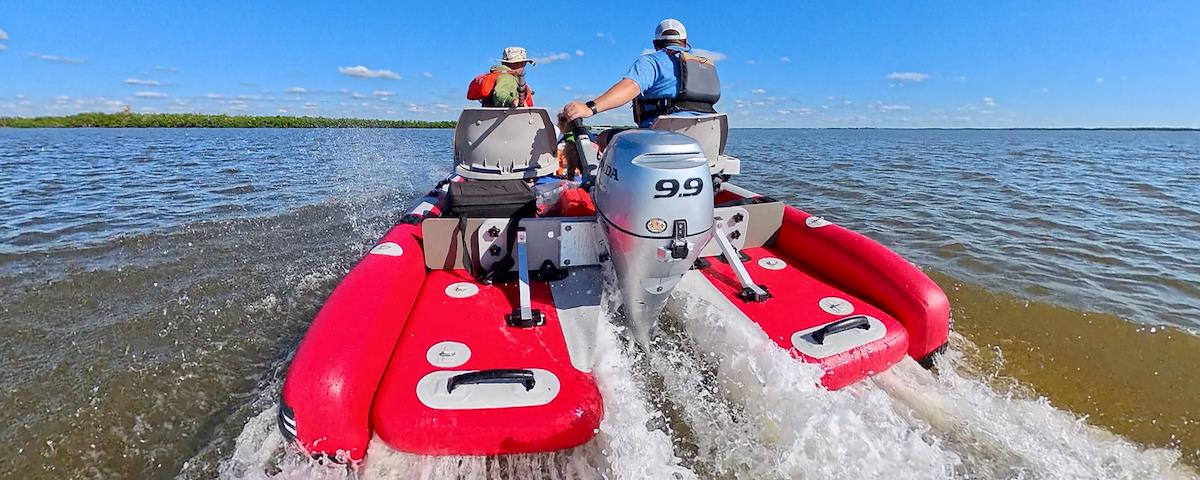
Price: $3,199 (hull) / $3,499 (Deluxe Package) Capacity: 1,600 lbs / 4 people Hull Weight: 139 lbs (111 lbs hull only) Dimensions: 14'4" x 6'8" (packs to 72" x 29" x 15") Setup Time: ~16 minutes with electric pump Motor: Up to 20 HP gas (stern) + 55 lb thrust electric (bow) Top Speed: 23 mph with 20 HP outboard
I haven't used the FastCat14 personally, so I'm going off specs and what other owners say about it. And they say a lot.
Fourteen feet of boat with a 6'8" beam. When people describe standing on the FastCat14, the word "dock" comes up constantly. That's because the twin hulls are spaced so wide apart that the platform barely rocks when people move around. Loading four adults, a cooler, fishing gear, and a motor? Still under its 1,600 lb capacity.
The 20 HP rating is what separates this from everything else on the list. At 23 mph you're covering water fast enough to actually explore a big lake, not just putter around the cove where you launched. The twin hulls slice through chop instead of bouncing over it, so the ride stays smooth even when the water gets lumpy.
Four independent air chambers. If one hull gets a puncture (which is already unlikely with 1000 Denier reinforced PVC and welded seams), the other three keep you afloat. That's the kind of detail that matters when your kids are onboard.
Who it's for: Families who want real boat capability without owning a real boat. Groups of 3-4 who fish together. Anyone who needs speed and capacity but doesn't want a trailer in their driveway.
The downside: 139 lbs total weight means you need a buddy to carry it from the car. It packs to 72 inches long, so forget about sedans. You need an SUV or truck bed. And $3,199 is real money. I won't pretend otherwise. But compare that to what a 14-foot rigid catamaran costs with a trailer, and suddenly it looks pretty reasonable.
[Check Current Price]
Pros
- 1,600 lb capacity handles families and full gear
- 20 HP motor reaches 23 mph. Real speed on the water
- 6'8" beam provides rock-solid stability
- 4 independent air chambers for safety
- 1000 Denier welded-seam construction lasts 10-15 years
Cons
- 139 lbs needs two people to carry
- 72" packed size requires SUV or truck bed
- $3,199 is a significant upfront investment
Our Verdict
Best overall inflatable catamaran for families and groups who want real boat capability without the cost of a real boat.
Best for Fishing: Sea Eagle FoldCat 375fc
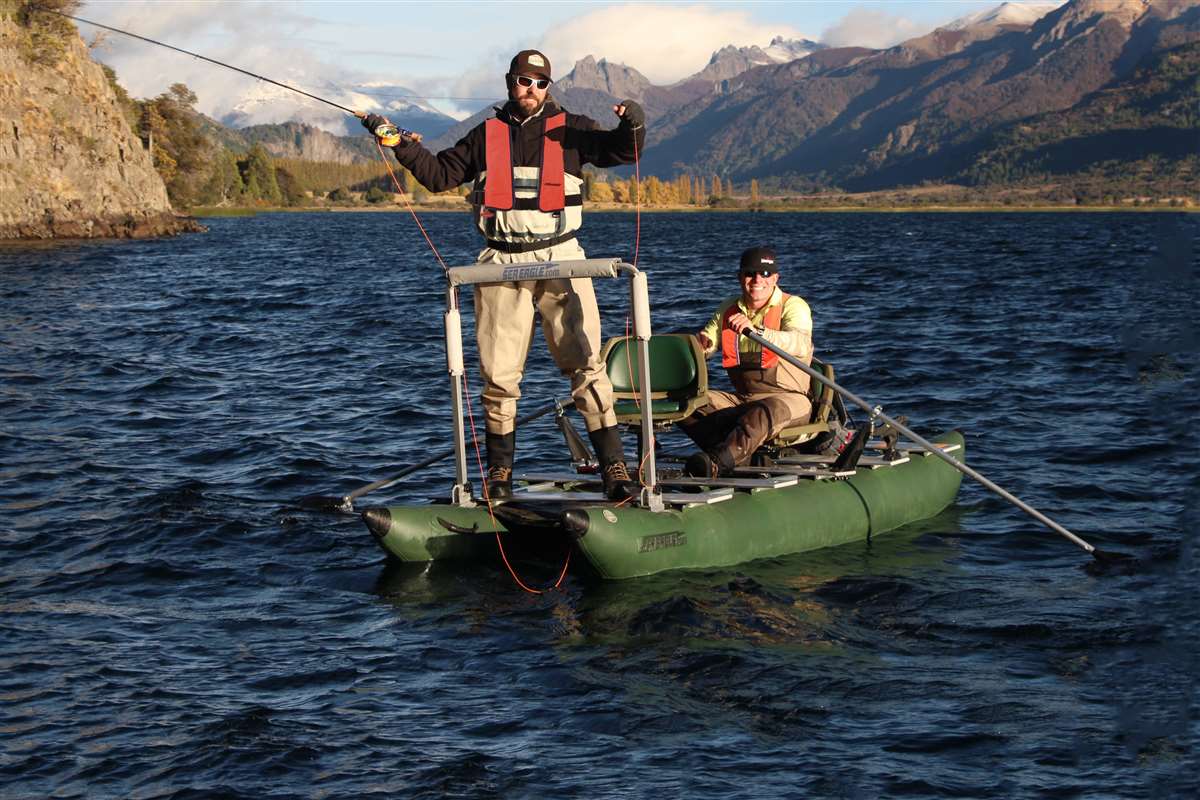
Price: $1,499 (hull) / $1,599 (Deluxe Package) Capacity: 650 lbs / 2 people Hull Weight: 65 lbs (104 lbs fully assembled) Dimensions: 12'4" x 4'6" (packs to 56" x 21" x 10") Setup Time: ~10 minutes Motor: Up to 3 HP gas / 70 lb thrust electric Top Speed: 8-10 mph (gas) / 4-6 mph (electric)
The FoldCat is the oddball of this list, and I mean that as a compliment. It looks weird. A folding aluminum frame that clicks together around inflatable pontoons, creating what amounts to a floating deck with rails. Nothing else on the market looks like it.
I haven't personally fished from this one, but I've talked to FoldCat owners at the ramp and the consistent thing they say is this: you can stand on it and forget you're on an inflatable. The rigid aluminum frame distributes your weight evenly across both pontoons. No wobble. No second-guessing. You stand up, you cast, you fight your fish.
The Scotty mount system is the other reason anglers gravitate toward this boat. Those universal mounts take rod holders, cup holders, fish finders, camera mounts. You set it up for how you fish, not the other way around. And the 10-minute setup is legit. I've watched guys at my local ramp do it in seven or eight minutes once they've got the routine down.
Who it's for: Anglers who fish calm lakes and ponds and want to stand up and cast. People who value stealth and portability. If fishing is the main reason you're buying an inflatable catamaran, this is the one built specifically for that job.
The downside: 3 HP max motor. You're not racing across the lake. You're trolling, drifting, and repositioning. That's fine for pond and lake fishing, but if you need to cover miles of water, this isn't the boat. And at 104 lbs fully assembled, it's a two-trip carry or you're bringing a cart. The 650 lb capacity also gets tight fast with two bigger adults, full tackle, and a motor.
[Check Current Price]
Pros
- Rigid aluminum frame for rock-solid standing
- Scotty mount system for custom rod holder placement
- 10-minute setup with patented folding system
- Welded 1000 Denier PVC for long-term durability
Cons
- 3 HP max motor limits range and speed
- 104 lbs fully assembled. Need a cart or buddy
- 650 lb capacity gets tight with two bigger anglers
Our Verdict
Best stand-up fishing platform. The rigid aluminum frame makes it feel like a floating dock, not an inflatable.
Best for Couples: Sea Eagle PaddleSki 437ps
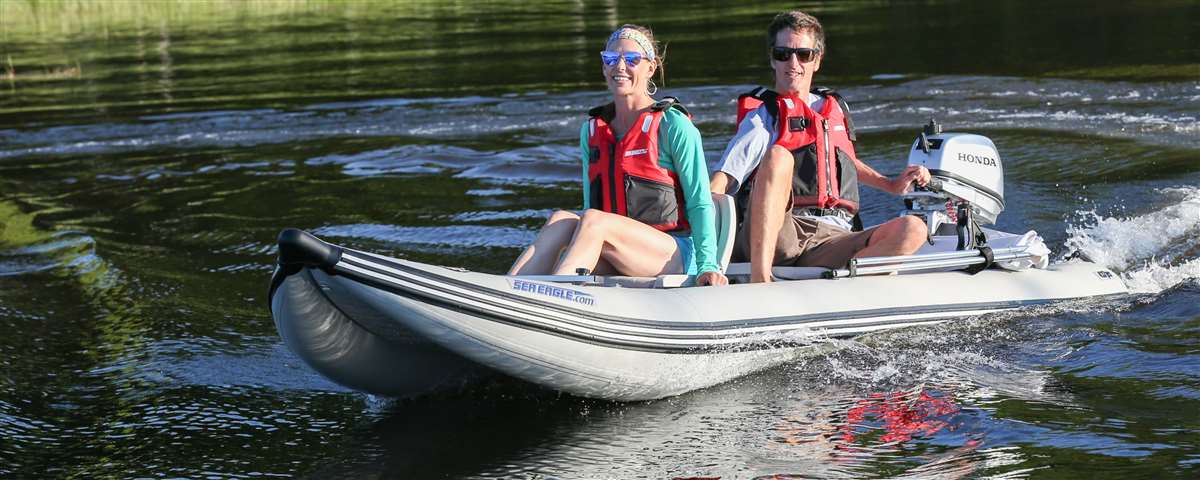
Price: $1,299 (hull) / $1,699 (Swivel Seat Package) Capacity: 855 lbs / 2 people Hull Weight: 58 lbs (68 lbs with transom) Dimensions: 14'4" x 4' (packs to 36" x 21" x 12") Setup Time: ~10 minutes Motor: Up to 6 HP gas / 70 lb thrust electric (stern); 55 lb thrust electric (bow) Top Speed: 16 mph with 5 HP outboard
This is mine. Two years. Probably 40+ trips. I know every square inch of this boat.
I keep it in my garage, inflated and ready to go. When I want to fish, I load it into my truck bed (or sometimes onto a small tow-behind trailer), drive to the ramp, and slide it right into the water. No inflation, no pump, no waiting. I'm on the water in minutes. You can deflate it and pack it into a sedan trunk (it rolls down to 36" x 21" x 12"), but honestly, once I realized I could just keep it inflated and toss it on the trailer, I never went back. That beats backing a real-boat trailer down a ramp while six strangers watch you try not to jackknife it.
At 58 lbs, it's light enough for one person to handle. Load it, launch it, done. That's the difference between "I'll go out today" and "eh, maybe next weekend." Every extra pound of boat is friction. The PaddleSki keeps that friction low, and keeping it inflated cuts the launch time to basically nothing.
The catamaran hull surprised me the most. I figured twin hulls were marketing speak. They're not. The PaddleSki tracks straighter when paddling than any single-hull inflatable I've tried. I run an electric trolling motor with a wireless remote, so I can steer from my seat without reaching back to grab a tiller. Total game changer. And the hulls cut through small chop instead of bouncing over each wave. I've had it out in 1-2 foot chop and felt fine. Wet, but fine. The self-bailing scupper holes let water in when things get rough. It drains. You deal with it.
Can I stand and fish from it? In calm water, yes. It's not as planted as the FoldCat's rigid frame, but I've caught plenty of fish standing up on this thing. I wouldn't try it in any kind of chop, but on a calm morning in the back bay? No problem.
The "Swiss Army knife" thing is real. I've paddled it like a kayak. I run an electric trolling motor most days, rigged with a wireless remote so I can steer hands-free while I fish. It takes up to a 6 HP gas outboard if you want speed, but I prefer electric. Quiet, no gas smell, and the fish don't scatter when I reposition. It does everything decently well. Not the best at any single one, but good enough at each that I don't need four separate watercraft.
Who it's for: Couples. Solo paddlers who want options. It packs small enough for a sedan trunk if you deflate it, or you can keep it inflated and toss it in a truck bed like I do. Either way, one boat that paddles, motors, and fishes.
The downside: At 14 feet long but only 4 feet wide, it's more like a tandem kayak shape than a wide platform. My wife and I with fishing gear and a motor? Tight. Workable, but tight. And the self-bailing I mentioned? Water comes in through those scupper holes in rough conditions. On a cold morning, sitting in a few inches of water is not fun. I've learned to check the forecast. Also, the seats in the base package are fine, not great. The Swivel Seat upgrade is worth every penny if you're fishing from it.
[Check Current Price]
Pros
- 58 lbs. One person carries it to the water
- Fits in a sedan trunk (36×21×12 inches packed)
- Paddle, motor, or fish. Four modes in one boat
- Catamaran stability for confident stand-up fishing
- Up to 6 HP gas motor for real cruising range
Cons
- 4-foot beam is narrower than wider catamarans
- Tight for two people with full fishing gear
- Self-bailing scuppers let water in during chop
- Base seats are mediocre. Swivel upgrade recommended
Our Verdict
The Swiss Army knife of inflatable catamarans. Paddle, motor, or fish from it. Best for couples and versatile solo use.
Best Budget: Saturn SD365
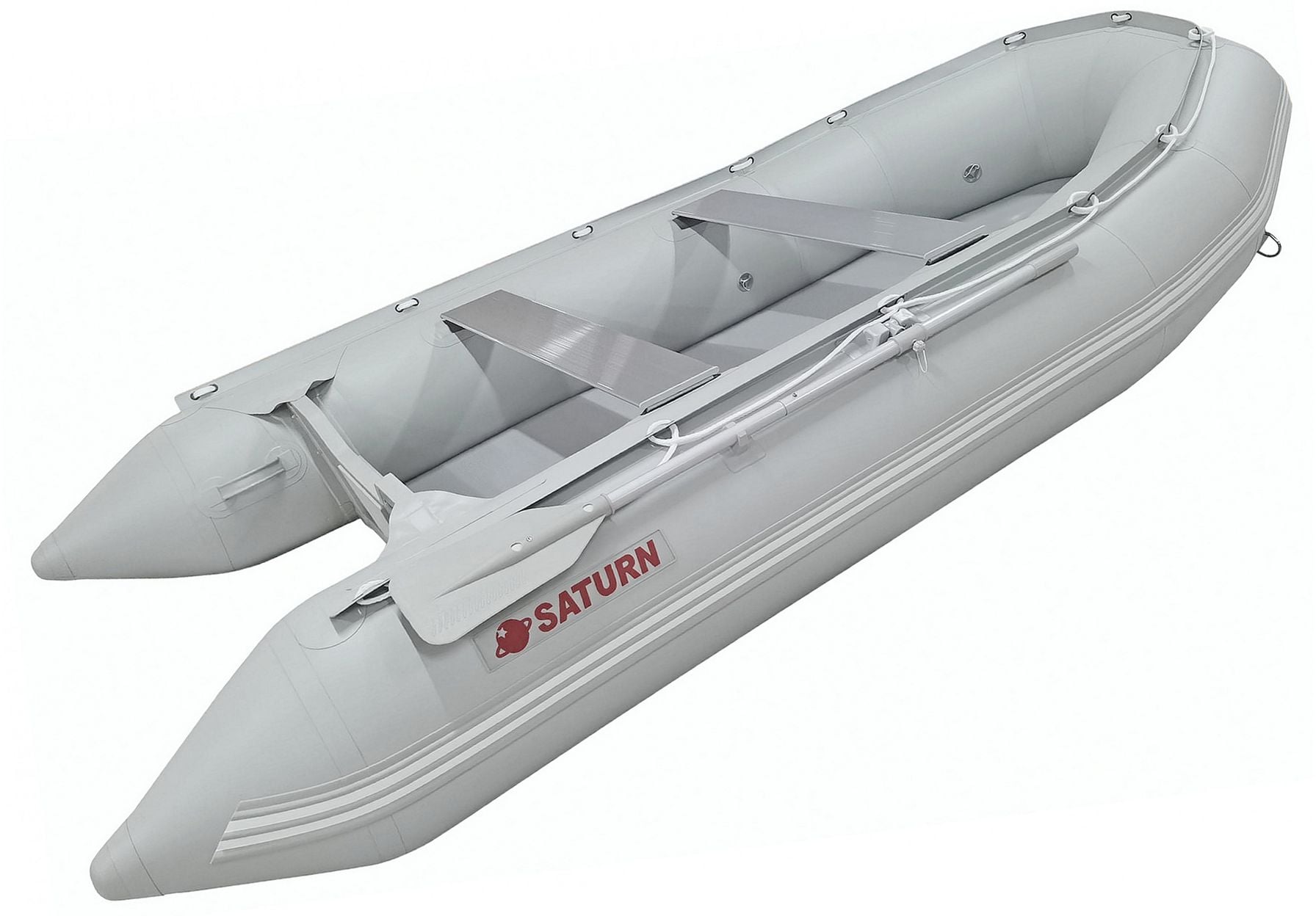
Price: ~$1,050 Capacity: ~4 people Hull Weight: Varies by configuration Dimensions: 12' length Motor: Compatible with small outboards Notable: Fully inflatable floor (no rigid inserts)
I haven't used this one personally, so I'm going off specs and what owners report online. And Saturn is the name that keeps popping up when people ask about inflatable catamarans under $1,200.
The SD365 is a 12-foot catamaran-style inflatable with a V-shaped keel. Calling it a "pure" catamaran is a stretch. It's more of a hybrid that borrows the planing characteristics of a catamaran hull. But it rides like one and it's priced like a regular inflatable, so it earns a spot on this list.
The fully inflatable floor is a real plus for storage. No aluminum boards to keep track of. No rigid panels to stack in your garage. The whole thing rolls up into one bag, smaller and lighter than any rigid-floor boat. If storage space is your main constraint, that matters.
Owner reviews I've read mention decent stability for the money, reasonable tracking, and a ride that's smoother than you'd expect for under $1,100.
Who it's for: First-time buyers. Casual weekend users. Anyone who wants catamaran-style stability without crossing the $1,500 line.
The downside: You get what you pay for, and I'm not going to sugarcoat it. Build quality is a step below Sea Eagle or Takacat. The inflatable floor won't feel as stiff as a drop-stitch or aluminum-board floor, so if standing stability matters to you, this isn't the right pick. Customer service reviews are mixed. And resale value is low. Budget inflatables lose value fast. If you can stretch your budget another $250-$400, the jump to a welded-seam boat from a reputable brand is the single best upgrade in this category.
[Check Current Price]
Pros
- Under $1,100 entry price. Lowest on this list
- Fully inflatable floor packs extremely small
- Decent stability for casual weekend use
Cons
- Glued seams (not welded). Expect 3-5 year lifespan
- Inflatable floor lacks stiffness for standing
- Mixed customer service reviews
- Low resale value compared to premium brands
Our Verdict
Gets you on the water for under $1,100, but spending $200–400 more for welded seams is the single best upgrade you can make.
Best Premium Tender: Takacat T340LX
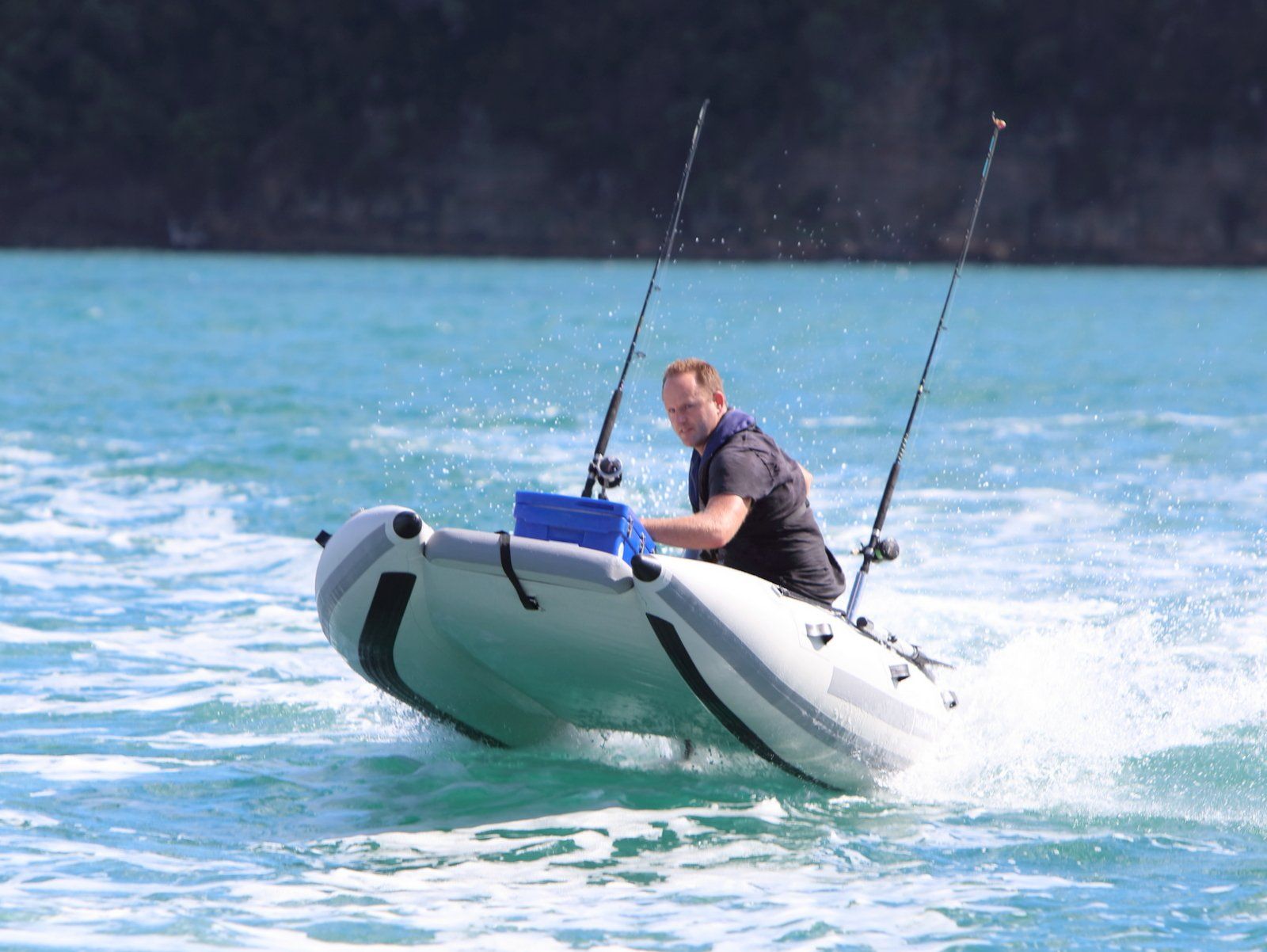
Price: ~$2,500+ (varies by region) Capacity: 1,135 lbs / 5 people Hull Weight: ~70 lbs Dimensions: 11'2" length Motor: Up to 10 HP Notable: Shallow draft, open bow design
I haven't used a Takacat, but I've gone down the rabbit hole on their engineering, and it's impressive.
Takacat is based in New Zealand and they build inflatable catamarans like actual boatbuilders, not like inflatable toy companies. Their LX series is designed for yacht tenders, beach landings, and shallow-water work. Situations where how deep the boat sits in the water matters more than how fast it goes.
The T340LX drafts just 3-4 inches. That means you can nose it right up to a beach where a regular dinghy would be scraping bottom 50 feet out. The open bow design lets people step on and off from the front, which sounds like a small thing until you've tried loading kids into a regular inflatable from the side in knee-deep water. It's a pain. This solves it.
Their "Tube Transom" system mounts the outboard motor without a traditional wooden or aluminum transom board. Fewer parts, lighter weight, and from what owners report, more durable than the standard setup.
Who it's for: Yacht owners who need a premium tender. Coastal folks who beach in shallow water regularly. Buyers who care more about build quality and engineering than price tags.
The downside: Hard to buy in the U.S. Most dealers are in Australia, New Zealand, and Europe. Pricing is all over the map depending on the dealer and your location, so budget $2,500 to $3,500 or more. And this isn't a fishing boat. No Scotty mounts, no rod holders out of the box. It's a tender and a cruiser. If fishing is your goal, look at the Sea Eagle options above.
[Check Current Price]
Pros
- 3-4 inch draft for ultra-shallow water access
- Open bow design for easy front boarding
- Tube Transom system is lighter and more durable
- Premium NZ boatbuilding quality and engineering
Cons
- Hard to buy in the US. Limited dealer network
- Pricing varies widely ($2,500–$3,500+ by region)
- Not set up for fishing out of the box
Our Verdict
Premium New Zealand engineering for yacht tenders and shallow-water cruising. Best-in-class build quality at a premium price.
How to Choose an Inflatable Catamaran
Five boats, five price points, five different jobs. Here's what actually matters when you're picking one.
Stability and Weight Capacity
Catamaran hulls are more stable than single-hull inflatables. Period. Two hulls spread the weight wider, and that width is what keeps you from tipping. Think of it this way. Try balancing on one foot versus standing with your feet wide apart. Same idea.
But the gap between catamarans is bigger than you'd think. Three things determine how planted you'll feel:
- Beam width: the distance between the hulls. The FastCat14's 6'8" beam is rock-solid stable. My PaddleSki's 4' beam is good, but I notice the difference.
- Floor type: drop-stitch floors and aluminum frames are stiffer under your feet than a fully inflatable floor. If you plan to stand, this matters.
- How you load it: keep your gear centered and low. Stacking a 40-lb cooler on one pontoon is asking for trouble.
On capacity: give yourself at least a 25% cushion. If a boat is rated for 650 lbs, plan your load for 500 lbs max. An overloaded inflatable sits low, tracks sideways, and feels sloppy.
Motor Compatibility
This is where inflatable catamarans really differ from each other.
| Boat | Max Gas Motor | Max Electric | Shaft Length | Max Motor Weight |
|---|---|---|---|---|
| FastCat14 | 20 HP | 55 lb thrust (bow) | 15" short shaft | 125 lbs |
| FoldCat 375fc | 3 HP | 70 lb thrust | 20" min | 45 lbs |
| PaddleSki 437ps | 6 HP | 70 lb thrust | 15" shaft | 60 lbs |
| Saturn SD365 | Varies | Compatible | Check specs | Check specs |
| Takacat T340LX | 10 HP | Compatible | Check specs | Check specs |
Shaft length is the mistake nobody warns you about. Buy a motor with the wrong shaft and you'll either have the prop cavitating in air or buried so deep the motor overheats. Check the manufacturer's shaft length spec before you buy anything. I learned this from a panicked 20 minutes on a forum the day after I ordered my motor. Don't be me.
Electric motors are worth a serious look. Quieter (fish don't scatter when you reposition), lighter, cheaper to run, and zero exhaust smell on your clothes. The trade-off is runtime: 2-4 hours before you need a charge. That's plenty for a small lake or pond. Not enough if you're spending all day on big water.
Setup Time and Portability
If portability doesn't matter to you, skip inflatables entirely and buy a rigid boat. The entire point of these things is that they fold up and go in your car.
My real-world setup times (not the manufacturer's "best case" numbers):
- FoldCat 375fc: 10-12 minutes. The aluminum frame has a learning curve but gets fast.
- PaddleSki 437ps: 10-15 minutes. I've got it down to about 10 on a good day.
- FastCat14: 16-20 minutes. More boat, more air, more steps.
- Saturn SD365: 10-15 minutes. Fewer parts helps.
- Takacat T340LX: 5-10 minutes. Built for fast deployment.
Packed size determines what car you need, or whether you even bother deflating. The PaddleSki packs to 36" x 21" x 12" and fits in a sedan trunk when deflated. I just keep mine inflated and load it into the truck. The FastCat14 packs to 72" x 29" x 15", and that's SUV or truck bed territory either way.
Yeah, 10-15 minutes of setup sounds like a hassle if you inflate every time. Pro tip: keep the boat inflated and load it onto a small trailer or into a truck bed. Skip the pump entirely. But even if you do inflate on-site, you know what takes longer than 15 minutes? Backing a big-boat trailer down a ramp on a Saturday morning while a line of trucks waits behind you and someone's asking if you're done yet.
Material and Durability
One thing separates boats that last a decade from boats that end up in a dumpster in three years: seam construction.
Welded seams are heat-bonded. They don't come apart in the heat, they don't weaken from UV over time, and they hold higher pressure. Every Sea Eagle on this list uses welded seams.
Glued seams use adhesive. They're cheaper to make, and they'll hold up okay for a while. But in hot climates, after a few seasons, the glue softens and the seams start letting go. If you're spending over a grand on a boat, make sure the seams are welded.
Material thickness is measured in Denier. Higher is thicker:
- 1000 Denier: The standard for quality inflatables. What Sea Eagle and Takacat use.
- 1100+ Denier: Heavy-duty. More puncture-resistant, but heavier.
- 840 Denier or lower: Budget range. Fine for calm lakes if you're careful. Don't drag it over rocks.
Drop-stitch construction is what lets you stand on an inflatable without it folding like a taco. It creates a rigid surface at high pressure (8-15 psi). If you plan to stand-up fish, look for drop-stitch floors.
Price vs. Value
The spread here is big: $1,050 to $3,500. Here's how I think about it as a dad who has to justify every purchase to his wife and his bank account:
Under $1,200 (Saturn range): Gets you on the water. Build quality corners get cut. Good for casual warm-weather use a few times a year. Not the boat to bet on if you're going out every weekend.
$1,300-$1,700 (PaddleSki, FoldCat range): The sweet spot. This is where I spent my money. Quality materials, welded seams, a real company that answers the phone if something goes wrong. You're getting 80% of the premium experience at half the price. With three kids, every purchase is a calculated decision, and this price range passed the test.
$2,500+ (FastCat14, Takacat range): You're paying for capacity, speed, and engineering that gets close to rigid-boat standards. Worth it if you're using the boat 20+ times a season or loading up the family regularly.
If you're torn between a budget option and a mid-range option? Spend the extra few hundred bucks. The jump from glued seams to welded seams is the single biggest quality upgrade in inflatables. You'll feel the difference every trip, and the boat will outlast the cheap one by years. That's not a sales pitch. It's what I'd tell a friend at a BBQ.
Are Inflatable Catamarans Stable?
Yes. And it's the number one reason I went with a catamaran hull over a regular inflatable.
Two hulls spread your weight across a wider platform than any single-hull boat can. Picture standing on railroad tracks versus standing on a balance beam. Same idea, different scale.
On my PaddleSki (which has a 4-foot beam) I stand up and fish in calm water regularly. I wouldn't do jumping jacks up there, but casting and reeling? Comfortable. The FastCat14's 6'8" beam is reportedly even more stable. Owners describe it as feeling like a floating dock.
In light chop (1-2 foot waves), catamarans handle noticeably better than single-hull inflatables. The twin hulls cut through small waves instead of riding up and over each one. Less bouncing. Less spray. More comfortable.
In rough water (2+ foot waves, serious wind), any boat under 15 feet is going to have a bad time, inflatable or not. Don't be a hero. Check the forecast before you launch.
The biggest stability factor is actually how you load the boat. Keep heavy stuff low and centered. If you stack your cooler and tackle box on one pontoon, you're going to feel lopsided. Spread the weight between the hulls and keep your center of gravity low.
Can You Put a Motor on an Inflatable Catamaran?
Almost every inflatable catamaran sold today takes a motor. The real question is how much power.
Smaller boats (under 12 feet) handle 3-6 HP gas or 55-70 lb thrust electric. That gives you 5-10 mph, enough for cruising, trolling, and repositioning without paddling. Fine for lakes, ponds, and calm rivers.
Bigger boats like the FastCat14 take up to 20 HP. At 23 mph, you're covering real distance. You're not stuck in the cove where you launched. You can run down the lake to the spot nobody else can reach.
Stuff I've learned from owning a motorized inflatable:
- Get the shaft length right. Wrong shaft means the propeller is either chopping air above the waterline or buried too deep and overheating. Check the spec sheet. Seriously.
- Electric trolling motors are amazing for fishing. Quiet approach. No gasoline smell. Fish don't spook when you creep up on a flat. The range trade-off (2-4 hours on a charge) is fine for most pond and lake trips.
- Motor weight affects everything. A 20 HP outboard weighs 90-125 lbs hanging off the back of your boat. That changes how the boat sits, how it trims, and how much total weight you're lugging to the water. Make sure your transom is rated for it.
- Wireless remote steering is a game changer. I rigged my PaddleSki with an electric trolling motor and a wireless remote. I steer from my seat without touching the tiller. Some setups use a bow-mount with foot pedal instead. Either way, hands-free steering while you fish is the move.
Inflatable Catamaran vs. Traditional Boat
This could be its own article, and I'm working on a full comparison. But here's the short version:
| Factor | Inflatable Catamaran | Traditional Boat |
|---|---|---|
| Price | $1,000-$3,500 | $10,000-$50,000+ |
| Storage | Closet, trunk, garage corner | Garage, driveway, or marina slip |
| Transport | Any car, no trailer | Trailer + tow vehicle |
| Maintenance | Rinse, dry, store | Winterize, hull work, engine service |
| Annual costs | ~$0 (no insurance or registration in most states) | $500-$3,000+ (insurance, slip, maintenance) |
| Speed | 5-23 mph | 20-60+ mph |
| Lifespan | 10-15 years (quality build) | 20-30+ years |
| Capacity | 2-4 people typically | 4-10+ people |
Traditional boats win on speed, capacity, and rough-water handling. No argument.
Inflatable catamarans win on everything else. Cost. Storage. Transport. Annual expenses. Hassle. Spontaneity. I can go from "nice day" to "on the water" in 20 minutes. Try that with a trailer boat.
The math that convinced me: I use my PaddleSki 30-40 times a year. At $1,299, that's roughly $16 per trip over two years. A comparable rigid boat experience (after the purchase, trailer, insurance, registration, storage, and maintenance) would cost 10x that per trip. I'm not bad at math. The inflatable made sense.
How Long Do Inflatable Catamarans Last?
A quality inflatable catamaran with 1000 Denier PVC and welded seams should last 10-15 years with basic care. That's not guessing. I've seen Sea Eagle owners in forums with boats pushing 12+ years of regular use.
The stuff that shortens that lifespan:
UV exposure. Sun slowly breaks down PVC. A UV protectant spray helps a lot. I store mine in the garage, out of direct sun. If I'm on the water all day, I rinse it off and put it away that evening. Leaving it inflated in your backyard for weeks at a time? That's how you age a boat fast.
Over-inflation on hot days. Air expands in heat. A boat inflated to the right pressure at 7 AM will be pushing its limits by 2 PM if it's sitting in the sun. I either inflate slightly under-pressure on hot days or pop a valve briefly at midday to let some air out. Takes 30 seconds.
Dragging it. Every time you drag an inflatable across concrete, gravel, or a rocky beach, you're wearing down the hull material. Use a cart. Or carry it. Two minutes of effort saves years of wear.
Saltwater without rinsing. I fish in saltwater back bays. After every trip I rinse the whole boat with fresh water from the hose. Salt crystals are abrasive. They eat at valves, seams, and hull material if you let them sit. Takes five minutes. Worth it.
Budget inflatables with glued seams? Expect 3-5 years. The seams start peeling and the floor gets soft. That's the trade-off for saving money upfront.
Frequently Asked Questions
What's the best inflatable catamaran under $1,500?
My PaddleSki 437ps at $1,299 for the hull. It's the most versatile boat in this price range. Paddle it, motor it, fish from it. If stand-up fishing is your main thing, the FoldCat 375fc at $1,499 is built specifically for that. Both are solid choices, just different priorities.
Can inflatable catamarans handle rough water?
Light chop (1-2 foot waves), yes. The twin hulls cut through small waves well and the ride is smoother than a single-hull inflatable. Serious rough water (big waves, strong wind), no. Any small boat under 15 feet has limits. I've been out in conditions I shouldn't have been in. The boat handled it fine. My nerves didn't. Check the weather.
Do you need a trailer for an inflatable catamaran?
No. That's the beauty of inflatables. Even the biggest on this list packs into bags that fit in an SUV. The PaddleSki deflates down to sedan-trunk size. Personally, I keep mine inflated and load it onto a small trailer or into my truck. Even faster since there's no pump-up time. No registration in most states, no storage fees.
What's the difference between an inflatable catamaran and an inflatable kayak?
Width and stability. Inflatable kayaks are narrow (2-3 feet wide) and sit low. They're built for paddling in one position. Inflatable catamarans are wider (4-7 feet), sit higher on the water, and give you a platform you can actually stand on, fish from, or mount a motor to. Catamarans are slower under paddle power but way more stable. For fishing or having a second person aboard, the catamaran wins big. For solo lake fishing with a paddle, a kayak might be fine.
Are inflatable catamarans good for saltwater?
Most quality ones handle calm saltwater: bays, inlets, coastal flats. My PaddleSki is NMMA certified and I use it in saltwater back bays regularly. Just rinse it with fresh water after every trip. Salt is hard on valves, zippers, and seam material if you let it dry on there. Five minutes with a garden hose after each outing and you're fine.
How do inflatable catamarans compare to inflatable pontoon boats?
Similar idea, different execution. Inflatable pontoon boats (like fishing float tubes) are typically smaller, sit lower to the water, and are built for one person. Inflatable catamarans sit higher, carry more weight, take bigger motors, and fit a second person. If you're fishing solo on a small pond, a pontoon float tube is cheaper. If you want speed, capacity, or a passenger, the catamaran is the way to go.
My Pick for Most People
If someone at a BBQ asked me "which inflatable catamaran should I buy?" (and this happens more than you'd think since I started talking about mine) I'd say the Sea Eagle PaddleSki 437ps at $1,299.
Not just because I own one and I'm biased. (I am, and I probably am.) But because it threads the needle that most first-time buyers are looking for. It's light enough for one person to handle. Deflated, it fits in a sedan trunk. Inflated, it slides into a truck bed or onto a small trailer. You can paddle it, motor it, or fish from it. The catamaran hull is genuinely stable. And the 1000 Denier PVC with welded seams means it's going to last.
Need more boat? Step up to the FastCat14 for families and groups. Fishing is your only priority? The FoldCat 375fc was designed for exactly that. Tight budget? The Saturn SD365 gets you on the water for a grand. Want the best-engineered tender money can buy? Look at Takacat.
But for the dad standing on the seawall, watching other people fish spots he can't reach, wondering if an inflatable is worth it? Yeah. It's worth it. I'd buy mine again tomorrow.
Related reading:
- Best Inflatable Fishing Boats for Lakes & Rivers
- Inflatable Catamaran vs Traditional Boat: Full Comparison
How I Review Boats
I buy my own gear with my own money. No press samples, no sponsorships, no manufacturer relationships. If I own it, I'll tell you exactly what I think after months of real-world use. If I haven't used it personally, I'll say that upfront and base my assessment on specs, owner reports, and conversations with people who actually own one.
Prices checked . Some links on this page are affiliate links. If you buy through them, I earn a small commission at no extra cost to you. That's how I fund buying more gear to review. Read more about how this site works.